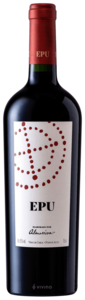


Almaviva EPU 2020
Rött vin från Puente Alto Chile1997 förseglade Baroness Philippine de Rothschild, ordförande i Baron Philippe de Rothschild SA:s rådgivande nämnd, och Eduardo Guilisasti Tagle, ordförande i Viña Concha y Toro S.A., ett partnerskapsavtal i syfte att skapa ett exceptionellt fransk-chilenskt vin vid namn Almaviva . Tillverkad under gemensam teknisk övervakning av båda partners, nådde den första årgången omedelbar internationell framgång vid lanseringen 1998.
| Per flaska: | Per låda: | |
| Pris |
649kr
|
3894kr
|
| Distrikt | Puente Alto |
| Druvor | Cabernet Sauvignon , Merlot , Cabernet Franc , Carménère |
| Årgång | 2020 |
| Procucenter | Almaviva |
| Artikelnr | 2996 |
| Beställningssortiment | |
| Lagerstatus | |
| Fraktkostnad | 169:- |
| Avnjutes mellan | 2023 - 2030 |
|
Fyllighet |
Fruktsyra |
Strävhet |

Här redovisar och presenterar vi kända vinskribenters utlåtande om specifika viner. Utöver dessa lägger vi in en egen kommentar när vi har provat samma vin.
Druvor
81% cabernet sauvignon, 12% carmenere, 5% merlot & 2% cabernet franc.
Tasting note
The current release of their second wine is the 2020 Epu. It's selected from the same terroir and vineyard in Puente Alto, one of the most reputed places for Cabernet Sauvignon in Chile, but from the younger vines (five to 20 years old) and harvested a little earlier to preserve acidity and fruit. In the warm and dry 2020 vintage, the wine was produced with a blend of 81% Cabernet Sauvignon, 12% Carmenere, 5% Merlot and 2% Cabernet Franc, usually higher in Cabernet and lower in Carmenere than Almaviva. It has red ripe berries, the textbook blackberries and cassis and some creamy oak. It's ripe at 14.8% alcohol and has mellow acidity, good freshness and balance, with a pH of 3.71 and 4.8 grams of acidity (tartaric). It matured for 12 months in French barriques, 10% new and 90% second use. The wine has a bright nose with a clean note of baked "morrón" peppers intermixed with red berry compote. It has a velvety palate with the luxurious texture of the modern Bordeaux, with abundant, slightly dusty tannins. It's approachable and round but should reward some time in bottle. This is a pretty serious Epu. 75,000 bottles produced. It was bottled at the end of 2021 and the first days of 2022. This is the second vintage sold through the Place de Bordeaux négociant system.
I tasted the 2020 Almaviva for its release through the Place de Bordeaux in September 2022. I am also including the note here for context and completeness of the Chile article.
I tasted the 2020 wines from Almaviva with winemaker Michel Friou, which represents Almaviva's 25th vintage. The 2020s were bright and expressive, nicely crafted, clean and with integrated oak. 2020 was a dry vintage (one big concern, 2021 and 2022 are almost the same) and also warm, so the wines have to reflect that condition with a very early harvest, almost three weeks earlier than the average. But having an early harvest was a blessing because Covid arrived. As on previous occasions, he provided some back vintages to give context, and the older wines consistently show an animal note. This time I had the 1996, which had hints of leather but felt very classical and still alive, with good color. The wines from the turn of the century show the effect of the new oak; the 2009 still has abundant notes of toast and smoke, with hints of roasted sesame seeds, and it was a ripe year—it still felt tannic, or perhaps the quality of the tannins is not the same as nowadays. I also revisited 2019, the previous vintage, which showed very much in line with the style of the 2020, cleaner, sleeker, velvety and caressing, still powerful but with elegance.
-
In 1997, Baroness Philippine de Rothschild, Chairman of the Advisory Board of Baron Philippe de Rothschild SA, and Eduardo Guilisasti Tagle, Chairman of Viña Concha y Toro S.A., sealed a partnership agreement with a view to create an exceptional Franco-Chilean wine called Almaviva.
Produced under the joint technical supervision of both partners, the first vintage achieved immediate international success upon its launch in 1998.
The name Almaviva, though it has an Hispanic sonority, belongs to classical French literature: Count Almaviva is the hero of The Marriage of Figaro, the famous play by Beaumarchais (1732-1799), later turned into an opera by the genius of Mozart.
The label, meanwhile, pays homage to Chile’s ancestral history, with three reproductions of a stylized design, which symbolizes the vision of the earth and the cosmos in the Mapuche civilization. The design appears on the kultrun, a ritual drum used by the Mapuche.
The label bears the name Almaviva in Beaumarchais’ own handwriting. Two great traditions thus join hands to offer the whole world a promise of pleasure and excellence.
The Château concept was introduced in the XIX century in France as a way to honor creative mastery of winegrowers from Bordeaux.
Almaviva was the first wine in Chile created under this French Château concept, taking into account exceptional terroir, one unique bodega and one technical team – the three of which are dedicated exclusively to the production of one wine of unparalleled quality and excellence.
The best of two cultures
Made from a blend of classic Bordeaux varieties, in which Cabernet Sauvignon predominates, Almaviva is the result of a felicitous encounter between two cultures.
Chile offers its soil, its climate and its vineyards, while France contributes its winemaking savoir-faire and traditions.
The result is an exceptionally elegant and complex wine. Its launch was a major milestone in the development of Chilean wines, both in Chile itself and in the international market.