

Bodega Chacra - Chacra Cincuenta y Cinco (1955) Pinot Noir 2023
Rött vin från Rio Negro Argentina« Elegant och ekologiskt enkelmarksvin framställt av vinstockar som planterades 1955. Rankas bland världens bästa Pinot Noirs jfr. James Suckling. Komplex Pinot Noir från en single vineyard. Chacra grundades 2003 av Piero Incisa della Rocchetta. Piero är barnbarn till Marchese Mario Incisa della Rocchetta, skapare av den legendariska Super-toskanska Sassacaia. »
| Per flaska: | Per låda: | |
| Pris |
699kr
|
4195kr
|
| Distrikt | Rio Negro |
| Druvor | Pinot Noir |
| Årgång | 2023 |
| Procucenter | Bodega Chacra |
| Artikelnr | 5726 |
| Beställningssortiment | |
| Lagerstatus | |
| Fraktkostnad | 169:- |
| Avnjutes mellan | 2025 - 2035 |
|
Fyllighet |
Fruktsyra |
Strävhet |

Här redovisar och presenterar vi kända vinskribenters utlåtande om specifika viner. Utöver dessa lägger vi in en egen kommentar när vi har provat samma vin.
Tasting note
Fresh and floral nose with tiles, vibrant red berries and pomegranate. Stony, mineral verve. Pure and expressive with good tension on the medium-bodied palate. Silky, very nimble and elegant. Acidic red berries in the finish that cleanse the palate. So much drinkability. Drink or hold. From biodynamically grown grapes.
-
James Suckling
-
Chacra has planted 0.31 hectares of Trousseau regrafted from Merlot that was planted in 2008, but the vines are not yet in production. For now, they continue with their range of Pinot Noir and two Chardonnays produced in conjunction with Jean Marc Roulot from Domaine Roulot in Meursault. As for the Pinot Noirs, 2017 was a warmish year with some really high peaks, but they changed the irrigation policy and gave the vines a lot less water than they used to; thus, the berries were smaller and ripened to perfection, and it could very well be the finest vintage they have produced to date. Proprietor Piero Incisa della Rocchetta told me that he thinks the improvement is all through work in the vineyards in general—not only irrigation—that they have changed and improved year after year. I had the chance to taste the whites with Incisa and Roulot, and they took time to explain the project. They have been close friends for a long time, but Incisa wouldn't dare ask Roulot to do a wine in Patagonia. But when the opportunity arose, Roulot was thrilled to explore a different place without the constraints they have in Burgundy. So, after visiting Río Negro in the winter of 2016, they got everything ready to start in the 2017 vintage. -
-
Chacra had some old Merlot that was part of the deal when they bought the 1955 vineyard, and they had produced a Merlot in the past. However, it was not a wine that fit in their Pinot Noir-only portfolio, so those 40-year-old Merlot vines were regrafted to Chardonnay and Trousseau. By chance, when they did their soils study with terroir expert Pedro Parra from Chile, they found out that plot was the "filet mignon" of their vineyard. So they got very excited about it. They are now planting more Chardonnay and regrafting some more, as they have the idea to build a small separate winery just for the Chardonnay. In 2017, they made 50 barrels that were divided into two wines. They applied Roulot's vast experience with whites and his famous obsessive fine-tuning of the pressing to avoid obtaining harsh flavors or textures in his search for elegant and mineral wines. They have not yet discussed the size of the project, but perhaps the limit might be some 200 barrels. It's a really exciting development, and the wines go straight to the top of the hierarchy of white wines from Argentina. They also had the luck to start in a very good vintage. A development that is worth following.
Robert Parker Wine Advocate
Since Piero Incisa della Rocchetta acquired the vineyards now known as Bodega Chacra, the estate has become Patagonia's leading source of Pinot Noir and a reference point for the entire region. In collaboration with terroir consultant Pedro Parra, pruning specialist Marco Simonit and winemaker Jean-Marc Roulot, Chacra achieves a level of harmony, depth and transparency unique within the region's offerings. Centered on the historic parcels planted in 1932, 1945 and 1955, now farmed organically and biodynamically, the estate spans 32 hectares on an ancient riverbed of predominantly sandy soils with calcareous and silt components and small pockets of clay. Plant material is exclusively ungrafted and pre-phylloxera, replenished as necessary from a proprietary nursery. In addition to Pinot Noir, small amounts of Torrontés, Trousseau, Malbec and Cabernet Sauvignon are co-planted at an average of 5,000 vines per hectare.
-
Vineyard work is where Chacra's identity is most deliberately constructed, and Incisa della Rocchetta has spent roughly two decades rebuilding these sites from the ground up. When he arrived, blocks of seven to 13 acres sat on depleted, bare soils, with stunted canopies leaving the plants unable to cope with Patagonia's intense luminosity. Thus began a comprehensive remediation, in which custom cover crops were formulated block by block to the specific deficiencies of each parcel; over 50,000 trees were planted across the estate, and canopy management has achieved a full square meter per plant so that each row shades the next in a cascading effect. Tilling has been abandoned in favor of occasional shallow cuts to oxygenate the middle of each row, on the logic that repeated tilling demolishes the biological complexity of the topsoil. In concert, these measures have lowered vineyard temperatures by as much as seven degrees Celsius in some blocks. The estate is both organic and biodynamic certified. However, it exceeds both standards in practice, producing 800 tons of its own compost from a neighboring goat farm's manure, making all of its preparations in-house, and using no chemical treatments of any kind, including copper. The old ungrafted vines self-regulate and, with their deep root systems, largely find their own water, supplemented by precisely timed minimal drip drawn from the river. The constant Patagonian wind thickens skins for disease resistance and structure, while the intense luminosity accelerates ripening so that phenolic maturity arrives with natural acidity intact.
-
Minimal intervention characterizes work in the cellar. Fruit is fermented with indigenous yeasts at cool temperatures in a temperature-controlled and solar-powered facility. Since 2015, all fermentations have been sulfur-free, typically without any acidification or enzyme additions, with malolactic completing at the tail of primary. Whole-cluster retention hovers around 50% from vintage to vintage, introduced by layering whole-cluster fruit with destemmed. Extremely gentle extractions, basket pressing and the reincorporation of press wine are standard, after which the wine moves by gravity to underground cellars. A short élevage of seven to nine months takes place in used barriques, primarily from Taransaud and Saury, amphorae and shallow concrete vats, completely avoiding new oak for the top bottlings. First-use barrels are generally blended into the Barda bottling before graduating upward throughout the single-parcel range, making for the rare occurrence in which a producer's introductory wine is also its richest. Since 2017, the natural acidity has been so well preserved that acidification has become extremely rare, contrasting its near-universal necessity in the estate's early years.
-
Two of the most impressive wines in the range come from a decade-long collaboration with Jean-Marc Roulot, resulting in some of the most expressive and unique white wines produced in South America. Roulot's precision at the press, his preference for firm pressing and taking a high proportion of solids to élevage, endows the whites with elevated levels of chalky, dry extract that make for what are often the most robust and muscular wines of the roster. Throughout the Chacra lineup, a common thread is a lithe, slender profile rendered with precision, with an approachability that somewhat belies how serious the wines are, which can easily be missed due to the combination of delicacy and their simply delicious nature. The 2025 reds are among the most uniformly excellent produced to date and mark the first vintage bottled entirely under Diam, the whites excepted, on which Roulot's preferences for natural cork prevail.
-
Robert Parker Wine Advocate
Relaterade produkter
Bodega Chacra - Chacra Cincuenta y Cinco (1955) Pinot Noir 2016
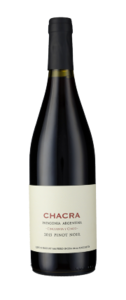
Bodega Chacra - Chacra Cincuenta y Cinco (1955) Pinot Noir 2024
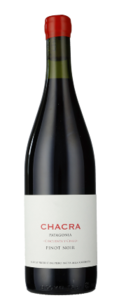
Bodega Chacra - Chacra Cincuenta y Cinco (1955) Pinot Noir 2015
Nyhet
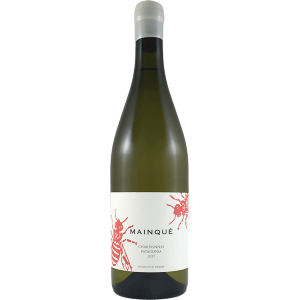
Bodegas Chacra - Mainqué Chardonnay by J-M Roulot & P. Incisa 2025