


Nyhet
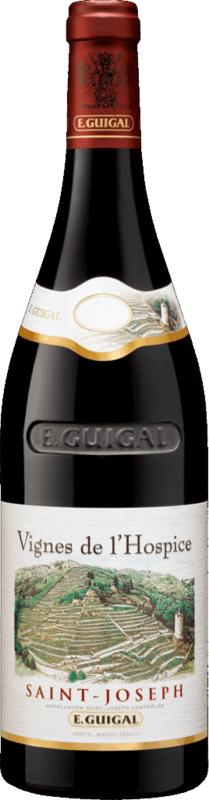
Guigal - Saint-Joseph Vignes de l’Hospice 2020
Rött vin från Rhône« E. Guigal är en av de mest anmärkningsvärda vinproducenterna i Rhônedalen. Det grundades 1946 av Etienne Guigal i Ampuis – där huvudkontoret finns kvar än i dag – på Rhônes västra strand, ett stenkast från de berömda solstekta sluttningarna av Côte Rôtie, och Guigals flaggskeppsviner, de berömda 'LaLaLa-viner': La Landonne, La Mouline och La Turque. »

Här redovisar och presenterar vi kända vinskribenters utlåtande om specifika viner. Utöver dessa lägger vi in en egen kommentar när vi har provat samma vin.
Druvor
Syrah
Tasting note
The 2020 Saint-Joseph Vignes de l'Hospice is more muscular than the Lieu-Dit Saint-Joseph, opening with a deep and complex bouquet of smoke, dark berries, spices, iris and violet, intertwined with delicate notes of mulberry. Full-bodied, dense and structured, it’s rich and ample, its controlled power framed by a firm chassis of ripe tannins, concluding with a long, mineral, pencil-lead-inflected finish. This will demand at least two decades of patience to reach its peak.
-
While the stars of the cellars are the single-vineyard wines from Côte-Rôtie, the Guigal family takes pride in all of the wines they produce, and one reliable indicator of the quality of a Southern Rhône vintage is the quality and volume produced of the négoce Côtes du Rhône, which is typically around 50% Syrah, 40% Grenache and 10% Mourvèdre. The 2018 is charming and fruit-forward, while the 2019 looks to be slightly more concentrated. The family's relationships in Gigondas go back before the elevation of that appellation to cru status in 1971, so that is another reliable southern offering from the négociant side of the business.
In the Northern Rhône, the large-scale bottlings from Condrieu and Côte-Rôtie are consistent performers and widely distributed. As they will be many consumers' introduction to these appellations, it's important they remain of high quality, vintage after vintage. The so-called La Las really require no introduction, except to mention that a new La La is being contemplated—a steep, two-hectare parcel within the Fongeant lieu-dit was vinified separately in 2019 and 2020. I was able to taste some impressive barrel samples, but as those wines will not be bottled separately, I've not scored them or added them to the database. Philippe Guigal was hopeful that the new wine—tentatively named La Renarde—would be ready to make a formal debut beginning with the 2022 vintage.
Value-oriented consumers who still want a taste of Northern Rhône Syrah will want to focus on the family's négoce bottlings from Crozes-Hermitage and Saint-Joseph. While the Crozes is normally a fruit-forward, easy-drinking wine, the 2019 version boasts a bit more concentration than usual, while the 2018 and 2019 St-Joes both deliver ripe fruit and hints of granitic austerity. The Lieu-Dit Saint-Joseph and Vignes de l'Hospice bottlings ratchet up the intensity of both oak and terroir, but prices for those are rising rapidly, as consumers have caught on to the value they represent.
As a side note, my tastings at Guigal's cellars in Ampuis included wines from the family's estate in Châteauneuf-du-Pape, Château de Nalys, but I've chosen to include those reviews in my Southern Rhône coverage, slated to appear in the next few weeks.
-
This year's visit to Guigal brought some intriguing news. To start with, the 2022 Côte-Rôtie La Reynarde will be the inaugural vintage of the fourth “La” within the iconic Guigal line-up. Named after the stream running between Côte Blonde and Côte Brune, the grapes are sourced from a 1.6-hectare steep plot within the Fongeant lieu-dit. After new vines were first planted between 2015 and 2019, Philippe Guigal bottled a single barrel separately as of the 2019 vintage. To provide better context and understanding before tasting the inaugural 2022 La Reynarde, he poured the 2019, 2020 and 2021 vintage samples for context. Each year, a greater proportion of fruit from these fairly young vines was ready to be used in the blend. While the fragrant 2019 had me thinking of a La Mouline with a little kick, tasting the more structured and denser 2020 and 2021 stylistically placed the La Reynarde closer to La Turque. Another interesting adaptation of the Guigal wines includes a change in cooperage. “More than 20 years ago, my father Marcel and I were looking for a partner to set up our family cooperage,” Guigal explained. “In 2003, we teamed up with a renowned cooper. One of the advantages of using their methods was that they made our wines more open and accessible – a great advantage in cooler years. Given the changing climate and increasingly higher temperatures, we started to feel that another solution was needed. After trying out many options, even from Austria and Slovenia, we landed on a partnership with a high-end cooperage located in Beaune. Not only do their barrels impart less vanilla flavor to our wines, but they also prevent the wines from unnecessarily opening up. The 2020 vintage saw a mixture of cooperages, while the 2021 will be the first vintage to fully show the in-depth work we achieved with this barrel change.” What has not changed is the heavy use of new oak in Guigal’s winemaking. “We stay true to the Guigal house style,” Guigal firmly points out. Having had dozens of spectacular mature Guigal wines from the past three decades, there isn’t much to hold against that stylistic choice; with the few exceptions of less ripe vintages, Guigal wines can handle the new oak. But there’s a caveat: The reds need time. In the case of the outstanding 2022 Côte-Rôtie La Landonne, time means holding off at least until 2037 to pop the first cork. Whether or not there is a sufficient number of consumers out there willing to wait that long is a different question.
-
Vinous
Relaterade produkter
Domaine Bressy-Masson - Les Ponchonnieres 2019

Château de Vaudieu - Châteauneuf-du-Pâpe Clos du Belvedere 2023

Château de Vaudieu - Châteauneuf-du-Pâpe Val de Dieu 2020

Nyhet
Domaine Raspail-Ay Gigondas 2023 [magnum]

