

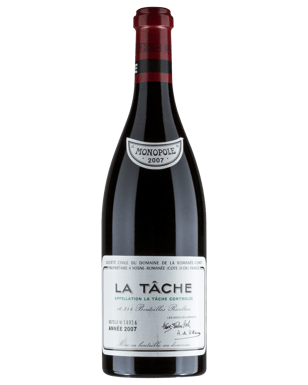
Domaine de la Romanee-Conti - La Tache 2016
Rött vin från Borgogne Frankrike« Romanée-Conti är inte bara namnet på världens mest kända vingård utan också namnet på den kanske bästa vinproducenten genom tiderna. »
I byn Vosne-Romanée, i hjärtat av Bourgogne, ligger det legendariska Domaine de la Romanée-Conti som är uppkallat efter själva vingården. Domaine de la Romanée-Conti, ofta kallad DRC, har en lång och anmärkningsvärd historia som har lett till att vinerna från DRC är allmänt erkända som några av de mest intressanta i världen - både ur ett dryckesperspektiv, men också ur ett investeringsperspektiv.
| Per flaska: | Per låda: | |
| Pris |
104866kr
|
104866kr
|
| Distrikt | Bourgogne |
| Druvor | Pinot Noir |
| Årgång | 2016 |
| Procucenter | Domaine de la Romanée-Conti |
| Artikelnr | DRC LT 104 |
| Beställningssortiment | |
| Lagerstatus | |
| Fraktkostnad | 169:- |
| Avnjutes mellan | 2026 - 2065 |
|
Fyllighet |
Fruktsyra |
Strävhet |

Här redovisar och presenterar vi kända vinskribenters utlåtande om specifika viner. Utöver dessa lägger vi in en egen kommentar när vi har provat samma vin.
Domaine de la Romanee-Conti
Domaine de la Romanée-Conti, allmänt känd som DRC, anses vara den mest prestigefyllda av Bourgogne och som en av världens största egendomar, med vingårdar belägna i de bästa delarna av Côte de Nuits.
-
Gården har fått sitt namn från sin mest kända vingård, Romanée-Conti. Samma vingård förvärvades 1232 av Abbey of Saint Vivant i Vosne, där munkarna förstod att de 1,8 hektaren var exceptionell terroir. Det är i denna vingård vinstockarna till det berömda vinet La Romanée-Conti växer idag. År 1631 tog familjen Croonembourg ägandet av domänen, som döpte om den till Romanée av okända skäl. När familjen Croonembourg bestämde sig för att sälja domänen 1760, blev den föremål för ett budkrig mellan Madame de Pompadour, älskarinna till Ludvig XV av Frankrike, och hennes bittra fiende Louis François, prins av Conti. Prinsen vann och vingården blev känd som Romanée-Conti.
Tasting note
More reserved than the Richebourg and Romanée-St-Vivant, the 2016 La Tâche Grand Cru unwinds in the glass with aromas of wild berries, licorice, rose petal, smoked duck and love, framed by a touch of cedary new oak. On the palate, the wine is full-bodied, rich and velvety, with a deep, concentrated but tight-knit core, its firm chassis of fine-grained, structuring tannins cloaked in succulent fruit, underpinned by juicy acids. The finish is long and reverberative. This is a stunning La Tâche in the making, but it is also one of the more reticent wines in the range and will demand some bottle age.
A morning spent with Aubert de Villaine provided an opportunity to taste the domaine's 2016 and 2017 vintages. From bottle, the 2016s are stunning, equalling or surpassing the profound 2015s. There is a vibrancy and weightless intensity to the wines that mark them out as very special indeed. When the Domaine de la Romanée-Conti produces a great vintage, there's nothing like it in Burgundy, and 2016 is a legitimately great vintage at this address. On the way to our tasting, we passed by the domaine's entire stock of 2016 Echézeaux and Grands-Echézeaux, bottled entirely in magnum. Those wines won't be released in early 2019: "perhaps we'll drink them, or release them later, we haven't decided", said de Villaine, pointing to a stack of bottles that would nonetheless elicit green envy in any other producer of those two appellations. Of vintage 2017, de Villaine reported that the domaine refrained from green harvesting in the belief that the vines' natural yield is the optimal yield. The wines, he observed, are "nicely balanced but slimmer than 2015 or 2016", an analysis with which I wholeheartedly concur, and to which I venture to add that the 2017s are suppler, more open-knit and will be adapted to comparatively near-term consumption. Moreover, after several years of low yields, there will, at last, be a certain quantity of wine to slake the thirst of an adoring—and sometimes, it must be said, uncritical—public. In 2017, it's also the case that the domaine's two monopoles stand head-and-shoulders above their other appellations in terms of depth, breadth and incipient complexity, a rapport that I've attempted to reflect with my scores.
I will refrain from being too voluble about the 2016s from this up-and-coming domaine because essentially it is irrelevant. Not the wines themselves, of course. Rather that they will not be available for many months after this report. However, their inclusion does permit their 2016s to be written in context of Burgundy as a whole, how their Echézeaux or Romanée-Saint-Vivant might compare to those of others. And it is fascinating to examine how the growing season affected the domaine, after all not even the most hallowed names were spared frost. Frost spreads its icy tentacle across the land and cares little for the signs signifying "DRC" and bolts off in another direction. If there was going to be any Divine intervention, then it would have to come from Aubert de Villaine and not above, and Aubert could not prevent the extensive damage in Echézeaux and Grands Echézeaux, cropped at six hectoliters per hectare and seven hectoliters per hectare, respectively. (We shall not speak about the Montrachet…you all know what happened there.) Now hold on, hold on. Put down that phone to your DRC agent. Remember that the domaine boasts considerably sized holdings, and so even despite yields that you can almost count on one hand, there are still 11 barrels of Echézeaux to be allocated to the entire world. The vintage report is written in Aubert’s poetic prose with references to Ulysses and Charybdis and other classic literary figures that I stupidly ignored at school. I do appreciate his candor in reporting some 35 attacks of mildew. A test of one’s biodynamic fortitude, they remained faithful to Steiner’s tenets, thanks to vineyard manager Nicolas Jacob armed with only copper and sulfur. The secateurs were unsheathed on 22 September to pick the Corton and finished on 29 September in Grands Echézeaux. Presumably with yields that low, the pickers could nip out for a few minutes and have the vineyard picked, little sorting necessary since the sanitary conditions were excellent. So, are the wines much good? Aubert’s nephew Bertrand de Villaine escorted me and two fellow reprobate wine scribes (one nameless fellow culpable of smashing his glass right next to the barrel of Romanée-Conti. Thankfully, there was no Romanée-Conti in it). A few observations that I made were that the oak was conspicuous on the Echézeaux, much more than the Grands Echézeaux, and the Richebourg exhibited the stem addition much more than the Romanée-Saint-Vivant. The Romanée-Conti made you want to weep it was so divine. We must await these 2016s in bottle to discover their true quality, but perhaps they were a more eclectic septet than usual, each with their own character. At the moment, perhaps they display the hand of the winemaker more than the terroir, though I expect that not to be the case once in bottle. Certainly there was an element of approachability here. Bertrand asked whether we could recall such a vintage where you could almost take that glass of Romanée-Conti and drink it like a finished wine? Racking my brain, I recalled 2006 from barrel, while fellow scribe Bill Nanson suggested the 2002 (good call, Bill). I cannot remember a vintage that I am so intrigued to plot a line between barrel and bottle. The growing season imbued the domaine’s 2016s with a soupçon of enigma. Yeah, but what does enigma taste like? For now, a mystery, but we will eventually find out.
Robert Parker Wine Advocate
Relaterade produkter
Domaine Christian Moreau - Chablis 1.Cru Vaillon 2022
Domaine de la Romanée-Conti - Romanée-Saint-Vivent 2019

Domaine Buisson - Saint Romain "En Poillange" Blanc 2022

Domaine Etienne Sauzet - Chevalier-Montrachet Grand Cru 2018

