

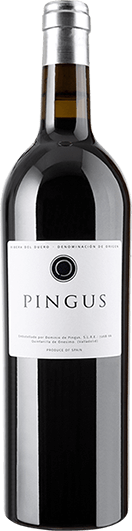
Dominio de Pingus - Pingus 2020 [singlebutelj]
Rött vin från Ribera del Duero Spanien« Peter Sisseck är ett av vinvärldens stora namn. Men namnet på Spaniens främsta kultvin är det faktiskt hans danska faster som ligger bakom. Det var hon som gav honom smeknamnet Pingus efter en dansk seriefigur när hon tröttnat på att blanda ihop honom med en annan Peter i släkten. »
| Per flaska: | Per låda: | |
| Pris |
16999kr
|
16999kr
|
| Distrikt | Ribera del Duero |
| Druvor | Tempranillo |
| Årgång | 2020 |
| Procucenter | Dominio de Pingus |
| Artikelnr | Pingus 105 |
| Beställningssortiment | |
| Lagerstatus | |
| Fraktkostnad | 169:- |
| Avnjutes mellan | 2024 - 2034 |
|
Fyllighet |
Fruktsyra |
Strävhet |

Här redovisar och presenterar vi kända vinskribenters utlåtande om specifika viner. Utöver dessa lägger vi in en egen kommentar när vi har provat samma vin.
Druvor
Tempranillo
Tasting note
The bottled 2020 Pingus has settled, and the strong Mediterranean accent that was quite strong early on seems to have calmed down. The wine shows more of the serious Pingus character and is harmonious, balanced and elegant, perhaps because of the time it spent in oak vat (starting this year, it is not only in barrique). It feels very complete and intense but without weight or heaviness, and the fruit shows very clean and focused. Peter Sisseck compared it with the 2000, a wine that for him transcends the vintage; it showcases the balance (wines like 1996, 2000, 2012, 2016 and 2018). The quality of the tannins is stunning, which make the wine very elegant and balanced, and it has good freshness (even some red fruit!). This is exceptionally good, but somehow my heart didn't beat like with the wines he compared them with... 7,500 bottles were filled in July 2022.
I tasted the bottled 2020s from Peter Sisseck and the samples from 2021 that I had already tasted last year. 2020 was the year of COVID-29, a very unusual year with circumstances previously unheard of. They had a lot of rain in spring that allowed for wines with finesse (which he compared with 1996 in some things). In 1995, he harvested late (October) with 1,200 kilos per hectare, and the wine did not reach 14% alcohol. If you did those yields and dates today, you'd get 20% alcohol, so there is a need to adjust viticulture. In 2020, they started harvesting on September 10 (which is early, but they started even earlier in 2022, on September 7), but the question is always about lack of concentration and green tannins. They are very careful with extraction, shorter pumping overs, etc.
He considers 2012 and 2016 years of change, and the wines are now subtler even if analytics are similar, but the perception is different. The experience is that when the wines are above 15% alcohol, they do not age well. 2020 has fine tannins, but it was a warm year of approachable wines, when they did a slightly longer élevage than he thought at first (they were bottled in July 2022 with some more time in tank because he bought a new bottling line).
There will be a new wine from 2021 produced by the next generation, Leonora Sisseck and husband Carlos del Río Jr., from a young vineyard planted with 15% Garnacha, produced in a young and fresh style, quite different.
I didn't taste anything from 2022, but he told me the result is better than expected, because he was seriously worried if they were going to be able to harvest any grapes at all!
Robert Parker Wine Advocate
Pingus
Peter Sisseck was born in Denmark in 1962. His relationship with the world of wine in general, and in particular with Bordeaux, was passed on to him by his uncle, Peter Vinding-Diers, a renown oenologist in the area and owner of a pair of châteaux in the Graves region: Domaine La Grave and Château de Landiras. In the 80s, Peter started to help his uncle, who at that time was revolutionising the production of white wines with his work in Château Rahoul. During his stays in Bordeaux, Sisseck contacted, among others, Jean-Luc Thunevin, famous for starting the movement of "garage wines" with his Valandraud. Sisseck was very interested in this new revolutionary movement and its new wines. According to references like Angélus, Le Pin, Cheval Blanc and Valandraud in Bordeaux itself, and Domaines Leroy, Dominique Laurent or the great Henri Jayer in Burgundy, he decided that if he were to start a personal project, this should be its course.
After helping his uncle in the notorious vintage of 1982, he finished his career as an agricultural engineer in Denmark a few years later. After he finished his studies, he visited California, specifically the Simi Winery in Sonoma, where he saw the American technological counterpoint, quite different from the French one he already knew. In the early 90s, he landed in Ribera del Duero to take charge of the technical direction of the new winery Hacienda Monasterio, where he continues to this day, and where he implemented new techniques that were unknown at the time in the area, such as grape selection tables. Once he was established in Ribera del Duero, Peter Sisseck began to take an interest in the old vineyards of the area and to think about his personal project: Dominio de Pingus.
Currently, Sisseck is also an advisor at Celler Mas Gil, under denomination of origin Catalunya, a property located in Calonge (Girona), which was bought in 1998 by six Swiss wine lovers, including Franz J. Wermuth, a wine merchant and auctioneer; Frank Ebinger from Casa del Vino, in Zurich; and Silvio Denz from Château Faugères (St. Emilion), who produced with the brand Clos d'Agon, white and reds, with around thirty hectares of vineyards.
History of the winery
In 1995, in Quintanilla de Onésimo (Ribera del Duero), he founded the winery Dominio de Pingus, a small winery in which he intended to recover the idea of artisan production and very careful preparation that he learned from his uncle at the very beginning in Graves. He called the winery Dominio de Pingus, "pingus" referring to Peter's youth nickname. It is a very small artisan winery, with a very low production. Here, the minimum detail of each of the wine production processes is taken care of. However, that first "garage winery" of Quintanilla de Onésimo has grown, giving way to a modest but perfectly equipped winery, concerned about the control of wines through its own laboratory. For sure, it could now be called a "boutique winery ".
Years 1996, 2000, 2001 and 2003 were the first large harvests of red wines from Pingus, until the extraordinary vintage of 2004, which received the first 100 points from critic Robert Parker. From this moment, a myth was born; it was almost impossible to find one single bottle. However, there is a fact that helped to reinforce the legend of Pingus. Most of the bottles, 4,000 from 1995 destined to the North American market, and all of the ones of Flor de Pingus, sank with the ship that was transporting them near the Azores islands, along with other important shiploads of other European wineries.
Work philosophy
Surprisingly, for someone who has so many Bordeaux roots, the methods used in his winery are clearly from Burgundy. This is, that the grape is harvested very ripe, and a cold pre-maceration of up to 10 days is carried out before the fermentation. Then, it is fermented in small wooden deposits, it goes through punch-downs instead of pump-overs, the malolactic fermentation is performed in barrels, and they use the "bâtonnage" technique, frequently used in white Burgundy wines, but unusual in the production of reds. However, at Dominio de Pingus the ageing takes place in barrels of the Darnajou cooperage from Lalande-de-Pomerol (Bordeaux), considered one of the best cooperages in the world. Another peculiarity of Sisseck is that, after the malolactic fermentation, the wine is transferred to a new barrel. This has been given the name "200% new wood", started by Dominique Laurent. Sisseck has used this technique in Pingus, but the "200% new wood" used at Pingus at the beginning has given way to an increasing percentage of used barrels. Currently, the production also recovers ancestral techniques such as fermentation in cement and ageing in large containers, with less presence of barrels.
However, the winery's greatest asset is the vineyard. The winery only has four plots of vineyard, with a total area of around 5 hectares for the production of its Pingus star wine. Here, biodynamic methods have been applied since 2000. One of the farms is called Santa Cruz, with the youngest vineyards, 50 years old, and with the highest yields. The vineyard of Baroso in La Horra is the most complete farm, and is actually a gravel tongue on a clay base, with limestone inlays that comprise a terroir with excellent drainage. It is formed of two different plots, one of 1 hectare, and the other of 2.5 hectares with vines of up to 60 years old. And last but not least, San Cristóbal, with 1.2 hectares, 70 years old, and with very, very low yields.
Wines from Dominio de Pingus
Pingus is the crown jewel. It is made with Tinto Fino grapes from the four plots of vineyards, a total of 5 hectares. The must ferments at a controlled temperature and performs the malolactic fermentation in barrels (70%) and in stainless steel deposits (30%). It is aged in French oak barrels (50% new and 50% single-use) for a minimum of 20 months. It is a wine with a powerful colour, with deep bluish rims, an explosion of black fruit on the nose, very fresh, with balsamic notes. In the mouth it has a considerable breadth, with a fantastic acidity and a sweet tannic richness, which enhances a very well balanced structure, with a long, powerful and very elegant finish.
Flor de Pingus is a wine concept different from Pingus. It is also made with Tinto Fino from 20 hectares of vineyard, currently almost all of them owned, in the area of La Horra. They are of an age between 25 and 50 years, some trained in vase-shape, and others in espalier. It is vinified in small thermo-regulated stainless steel vats. 50% of the wine performs the malolactic fermentation in barrels, and the rest in stainless steel deposits. 40% is aged in new Allier French oak barrels, and the rest in single or second-use French barrels for about 18 months. It has a wide range of aromas of red and black fruits, with spicy notes of vanilla, liquorice, and some fresh balsamic and mineral notes. In the mouth it has a good attack, it is very well structured, with firm but tasty tannins, that boost a sweet finish full of ripe fruits.
Psi was born to help prevent the disappearance of historic vineyards conducted in the traditional way by families of winegrowers of the area. The first vintage of PSI was the one of 2007. It was vinified with the collaboration of a few winemakers from Ribera del Duero. Since then, vineyards from new farmers have been added to the project, contributing with their diverse terroir to produce a multifaceted wine. Since the vintage of 2012 it has a small percentage of Red Grenache from old vines planted in Castrillo de la Vega (Burgos), which gives the wine a fresh, lively and elegant breadth. The Tinto Fino comes from seven large areas of Ribera del Duero that represent a large part of the vineyard from past generations. It is physically produced in 7 different wineries, using two selection tables and their own deposits. It is made in traditional cement deposits, and aged for around 18 months in second and third-use oak barrels from Pingus, as well as in large foudres and cement deposits.
However, and as an anecdote, the most unknown label of Pingus is Amelia. This wine comes from an old plot in La Horra (Burgos), planted in 1890 with roughly 500 vines. Peter Sisseck considers that they own the most perfect clone of Tempranillo, which he frequently uses to replant vines in the vineyards that supply grapes for Pingus. The grapes from this plot were originally destined to Flor de Pingus, but from 2003 they are bottled separately. Hardly one barrel is made, and it is exported to the North American market.
Relaterade produkter
Pago de Los Capellanes - Crianza 2023

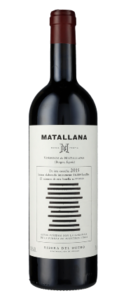
Telmo Rodriguez - Matallana Ribera del Duero 2021
Mauro 2021

Dominio de Es - La Diva 2024 [en primeur]

