

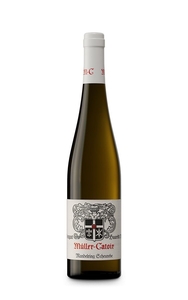
Müller-Catoir - Mandelgarten Riesling 2023
Vitt vin från Pfalz Tyskland« Dry white wines from Müller-Catoir continues to be some of the best from Germany » - James Suckling
| Per flaska: | Per låda: | |
| Pris |
429kr
|
2574kr
|
| Distrikt | Pfalz |
| Druvor | Riesling |
| Årgång | 2023 |
| Procucenter | Müller-Catoir |
| Artikelnr | MC 122 |
| Beställningssortiment | |
| Lagerstatus | |
| Fraktkostnad | 169:- |
| Avnjutes mellan | 2024 - 2034 |
|
Fyllighet |
Fruktsyra |
Sötma |

Här redovisar och presenterar vi kända vinskribenters utlåtande om specifika viner. Utöver dessa lägger vi in en egen kommentar när vi har provat samma vin.
Druvor
Riesling
Tasting note
From Gimmeldingen, the 2021 Mandelgarten Riesling Spätlese VDP. Erste Lage opens with a pure, fresh and crystalline/saline, slightly flinty bouquet of bright and spicy Riesling fruits. Light, lush and round on the palate, this is a filigreed and uplifted Spätlese with saline and crystalline acidity and stimulating grip on the finish. Just-ripe and crunchy, this Spätlese should be cellared for at least another 5 or 6 years. 10% stated alcohol. Natural cork stopper. Tasted in December 2022.
During the spring and early summer of 2021, farm manager Martin Franzen felt transported back to the 1990s, when last year's vegetation was still considered normal. From the end of June, this was followed by heavy waves of Peronospora, which took a heavy toll on organic viticulture. "With a great deal of time, however, we weathered this phase well, and the harvest yield was even slightly above the average of recent years," Franzen reports. It wasn't until the end of August that "the weather tipped back from the 1990s to our current times. The summer became humid, the nights often remained warm." The ripeness level at the end of August was anything but homogeneous, reports Franzen. "In addition to ripe grapes, unripe ones hung not only from vine to vine, but even on a single vine." He therefore made a green harvest in all vineyards to pick and separate 10% to 25% of the grapes. "This was important and resulted in balanced, full ripeness with stable but not excessive acidity levels." The harvest then started in mid-September.
However, the very warm fall weather resulted in erratic ripening, which required very fast, individual harvesting. The main harvest then ended in mid-October before the big rains. Thus, 2021 in Neustadt-Haardt was again a year of fast, selective handpicking, still cutting away 5% to 10% of the berries because they were green or brown and not golden yellow. "The trick in 2021 was to achieve sufficient fruit ripeness in the fresh, cool vintage and to do so with perfectly healthy grapes." Actually, 2021 was quite similar to 2004, Franzen believes.
Back then, Müller-Catoir was world-famous primarily for its sweet and noble-sweet Prädikat wines, particularly Rieslaner and Scheurebe. Martin Franzen, on the other hand, has elevated the dry wines to the rank of Erstes Gewächs and Grosses Gewächs, and it is they that are consistently convincing, while among the Prädikats in 2021, only the Rieslaner Auslese and Beerenauslese from the Herzog fascinated me. Otherwise, among the dry wines, I find hardly any substantial differences between the Grosses Gewächs and the Rieslings from the Erste Lage. Both the Grosses Gewächs and the Erstes Gewächs from the Bürgergarten are expressive single-vineyard wines.
Anyway, the site does not explain everything. Since Franzen has been at Müller-Catoir—that's almost 20 years now—a mixture of at least six different clones has been planted in all new vineyards in order to have genetic diversity right from the start. "In the early days, these were the classic German quality clones combined with material from Alsace and the Jamek selection from Austria. For about 10 years, I have been using the new Geisenheim clones of the 300 series, which was built up from ancient Mosel Riesling vineyards. So, finally we have good plant material available again." Again, six to eight different clones are mixed in new plantings. Old plants—the Flurbereinigung (land consolidation) in Haardt already dates back more than 57 years—are also repeatedly rejuvenated with this material, so that a colorful mix of younger and medium-aged vines stands next to the original vines. "Most of our crus come from these plantations," says Franzen, for whom the mix of different clones of different ages is "a basic building block for individuality and vitality in the wine."
Robert Parker Wine Advocate
AWARDS
- 2022: James Suckling: 94/100 "A fragrant and graceful dry riesling that shows how attractive and beautifully balanced the 2022 vintage wines can be. Delicate peach and floral aromas with fascinating detail. After a little aeration in the glass you feel the underplayed power more and the finish gains in length. Built to last."| enos Riesling Challenge: 2nd place
- 2020: wein.plus: "Restrained, relatively cool, fairly light yellow fruity nose with vegetal and mineral nuances. Ripe, juicy, light fruit, floral and vegetal notes, lively acidity and some grip, persistent on the palate, still a touch muted, certain depth, distinct mineral notes, very good, quite firm finish. " excellent (90 WP) top position | James Suckling: 95/100 "Such a joyful, floral nose with notes of rose and honeysuckle, plus a hint of smoke. And that’s only the beginning for this dry riesling, which can hold its own with any number of GGs, thanks to the impressive concentration of citrus fruit and nectarine. The vibrant acidity and subtle mineral freshness underline each other at the very long and expressive finish. Drink or hold."
- 2017: James Suckling: 95/100 | Finalist "Vinum Riesling-Champion 2018"
Relaterade produkter
Müller-Catoir - Bürgergarten Riesling Erstes Gewächs 2018

Nyhet
Müller-Catoir - Haardt Riesling 2024

Müller-Catoir - Mandelring Scheurebe Erstes Gewächs 2024
Dr. Bürklin-Wolf - Wachenheimer Riesling Pfalz 2022

