

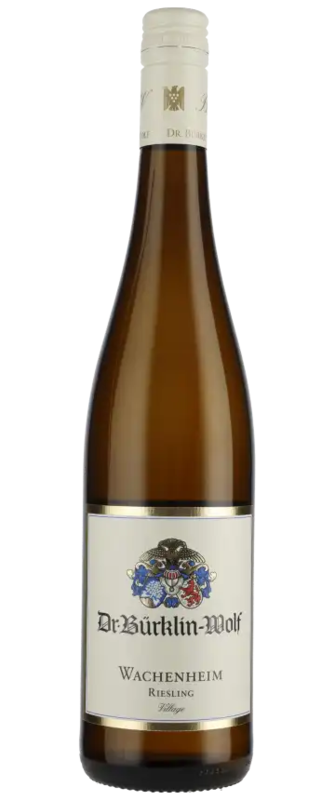
Dr. Bürklin-Wolf - Wachenheimer Riesling Pfalz 2022
Vitt vin från Pfalz Tyskland« Wachenheimer Riesling är gjord av druvor från vingårdarna Gerümpel och Rechbächel nära staden Wachenheim. Vinet kombinerar Gerümpelfältets finess och uttrycksförmåga med Rechbächelfältets karakteristiska struktur. Wachenheimer Riesling erbjuder en komplex bukett blommor, citrus och mineraler. Smaken är ett skolexempel på Bürklin-Wolfs torra, exakta stil och eftersmaken är elegant och snyggt strukturerad. »
| Per flaska: | Per låda: | |
| Pris |
329kr
|
1974kr
|
| Distrikt | Pfalz |
| Druvor | Riesling |
| Årgång | 2022 |
| Procucenter | Dr. Bürklin-Wolf |
| Artikelnr | Bürklin Wolf 104 |
| Beställningssortiment | |
| Lagerstatus | |
| Fraktkostnad | 169:- |
| Avnjutes mellan | 2024 - 2045 |
|
Fyllighet |
Fruktsyra |
Sötma |

Här redovisar och presenterar vi kända vinskribenters utlåtande om specifika viner. Utöver dessa lägger vi in en egen kommentar när vi har provat samma vin.
Druvor
Riesling
Tasting note
From downgraded premier crus and 80% vinified in large oak casks, the 2022 Wachenheim Riesling Trocken Village is clear and intense but also subtle on the distinctive nose and clearly characterized by the red sandstone soils. This Riesling trocken shows perfectly ripe, very noble and finely flinty fruit intermingled with laurel and celery aromas. Lush and refined on the palate, with lingering salinity and crystalline acidity, this is a very elegant, lush and balanced Wachenheimer with a fine and lively but rested character and a fine, saline finish. 12% stated alcohol. Screw-cap closure. Tasted at the domaine in November 2023.
The weather in 2022 was "not bad at all," says Nicola Libelli, cellar master and technical operations manager at Bürklin-Wolf, "at least until the beginning of July." There was still rain in June, but a dry phase lasting several weeks set in in July. However, this led more to "stress in the head" than in the well-supplied vineyards, which have been cultivated biodynamically for many years and have their own compost.
"We have been building up the soil there for more than 20 years, planting and cultivating it and, where necessary, systematically reducing yields. This was particularly necessary in the young plants in order to relieve the pressure on the vines during the drought," explains Libelli.
However, even in a challenging vintage such as 2022, there is no rule except to take a close look at each plot during the growing season in order to decide what needs to be done. Libelli undertakes these "tours" with his field manager Jan Hock, who both have a great passion for their own compost, which Libelli describes as a "game changer."
"Thanks to our measures, our humus content has risen from 1% to 3%," explains Hock.
That may not sound like much, but it is more than respectable given the fact that only around 0.1% humus can be built up each year. "The humus helps to buffer weather extremes, regardless of whether they bring prolonged drought or heavy rainfall," says Hock.
Also noteworthy are the low pH values, which were 3.1 in the 2018, 2020 and 2021 vintages according to analyses.
In the third week of August 2022, it then rained "a little," says Libelli, and the greenery sprouted. But then? "It really rained! ... September was an extremely wet month with over 100 liters of rainfall. But we were still able to harvest during the dry phases. The grapes were ripe, even physiologically ripe." It was a stop-and-go harvest. "We picked seven to 10 days before most of our colleagues and were ridiculed for it. But we have rather light must weights, which are based on ripe fruit."
The chilled, handpicked grapes for estate wine were pressed at 84° Oechsle, but even the warm Kirchenstück, "the Montrachet of the Palatinate" according to owner Bettina Bürklin-von Guradze, yielded grapes that were no higher than 92° Oechsle.
"When harvesting, we look for ripeness but also for tension and complexity," says Libelli, who wants to produce "clear, fine, pure and, at the same time, complex" Rieslings that have "all the vibrant power, tension and structure that you can expect from some of the greatest terroirs in Germany,"
The estate's total yield for Riesling 2022 averaged 36 hectoliters per hectare. This is well below the maximum limit for the VDP quality level "Grosses Gewächs" (GG), which is referred to here as "G. C." (for grand cru). "That was the amount that the vines were able to produce in a vintage like 2022 without suffering," says Libelli.
The collection of the 2022 vintage at Bürklin-Wolf is outstanding and marks one of the best vintages in the whole of Germany. The 2022 Pechstein G. C. is one of the outstanding Rieslings of the vintage, possibly even ahead of the even more expensive Kirchenstück G. C.
If you want to find the finest Rieslings without having to bleed financially, you will also find them among the premiers crus, among which the Wachenheimer Gerümpel P. C. and the Böhlig P. C. come closest to the grands crus in terms of finesse and expression.
The dry Village Rieslings are always a safe bet, and in 2022 the Weissburgunder Gutswein also stands out. This is a classy Pinot Blanc to go with food, which Libelli describes as "our Aligoté."
Even the estate wines ("Gutswein") at Bürklin are partly vinified in wood (40%, with 60% in stainless steel) and have been fermented at higher temperatures since 2020 to complete fermentation quickly and completely and avoid any hint of cheesy fruit aromas. A long sur lies aging period, during which malolactic fermentation may take place, also contributes to this.
Due to the quantity of 8,000 bottles, there are up to five bottlings of the Riesling estate wine, which remains on the lees until March, each with a different length of élevage on the fine lees.
The premiers crus lie on the lees until May, the grands crus until June. Bottling takes place one month later in each case. The grands crus are not put on sale until April of the following year. However, top wines such as Kirchenstück and Pechstein are usually sold out by the fall.
In the last three years in particular, the Dr. Bürklin-Wolf has established itself as a model German domaine whose Rieslings are a benchmark.
Men tyskt vin? | Du menar den där söta sörjan och som alltid är sååå otrendigt? Tänk igen. Det är ingen tvekan om att tyska viner har fått ett dåligt rykte, speciellt i Sverige, mestadels på grund av billiga volymimporter under sjuttio- och åttiotalen.
Tyska viner var något som man blev packad på – en studentdryck och för dem som inte visste bättre. Detta var imagen som vi växte upp med. man är så nöjd med att se denna bild raseras efter att ha sköljt ner glas efter glas av excellenta viner från Rheingau under mina senaste resor till regionen. Allt från friska, fräscha, fruktiga och mineralrika Rieslings till mer storartade något-som-sänts-från-himlen delikata Beerenausleses. Tyska viner har definitivt lämnat ett intryck som är här för att stanna. Och denna gång är detta nya rykte av mer positiv karaktär.
-
Den tyska vinindustrin är mest känd för Riesling i världsklass producerad längs Rhen och dess biflod Mosel. Det råder bred enighet om att de vita vinerna från de bästa platserna och de mest välrenommerade producenterna är några av de största i världen. Tyska vinmakare bevisar på ett övertygande sätt att de också kan producera bra vin från andra sorter, delvis med hjälp av klimatförändringarna. Till exempel växer nu fina tyska Spätburgunder (Pinot Noir) upp från olika regioner, särskilt Baden, Pfalz och till och med den lilla Ahr-dalen. Landet skröt omkring 102 000 hektar (252 000 tunnland) vingårdar. Detta placerade Tyskland på 14:e plats i världen.
Relaterade produkter
Dr. Bürklin-Wolf - Wachenheimer Gerümpel 1. Cru 2021

Müller-Catoir - Bürgergarten Riesling 2016

Müller-Catoir - Herrenletten Riesling 2023

Dr. Bürklin-Wolf - Wachenheimer Böhlig PC Pfalz 2014