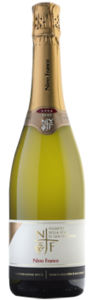


Silvano Follador Valdobbiadene Prosecco Superiore Brut Nature DOCG 2024
Mousserande vin från Venetien ItalienThis Prosecco is No.5 at James Sucklings list of the 29 best Proseccos, October 2016.
Aromas of lemons and grape, ginger and honeysuckle follow through to a full body with intense lemon-rind and citrus undertones. Some granite and minerals. Superb. Drink now.
| Per flaska: | Per låda: | |
| Pris |
319kr
|
1914kr
|
| Distrikt | Veneto |
| Druvor | Glera , Verdiso , Perera , Bianchetta |
| Årgång | 2024 |
| Procucenter | Silvano Follador |
| Artikelnr | 5515 |
| Beställningssortiment | |
| Lagerstatus | |
| Tillbaka i lager | Juni 2025 |
| Fraktkostnad | 169:- |
| Avnjutes mellan | 2025 - 2029 |
|
Fyllighet |
Fruktsyra |
Sötma |

Här redovisar och presenterar vi kända vinskribenters utlåtande om specifika viner. Utöver dessa lägger vi in en egen kommentar när vi har provat samma vin.
OUR SHORT HISTORY
Upon finishing secondary school we two siblings decided to carry on the activity of our paternal grandfather, who had died in 1999. Our original 2 hectares under vines (1.5 of which in the Cartizze sub-area) saw the addition at a later date of another 2 hectares inherited from our maternal grandfather. All this land is suited to the cultivation of the Prosecco vine. Being inexperienced, for the first few years we relied on an external consultant who strongly influenced the expression of our wines, which, although free of defects, were somewhat flavourless and dominated by overwhelming fermentation aromas. They were wines with no character, which had undergone impoverishing and standardising oenological practices. The varieties of wine we were producing had quite high sugar residues (12 g/l in the brut, 17g/l the extra dry and 25 g/l the Cartizze dry).
We were working for the market and not for ourselves. The number of bottles grew exponentially, which only seemed to confirm that this was the right way to work. We no longer had enough of our own grapes and therefore decided to buy extra ones from other farmers in the area.
In 2007, however, the urge to acquire a more intimate and personal relationship with our wines and our land became imperative and so we stopped working with external consultancy. Back in 2004 we had already started to take an interest in organic and then biodynamic farming. We felt the need to give our wines back their dignity and genuineness. We realised that to achieve this, respect for the life of the soil and the physiology of the plants had to take priority. We eliminated weed killers and chemical fertilisers. Starting in 2005 we began to use biodynamic preparations 500 P and 501 and spread composted manure and humus, depending on soil requirements.
We no longer used any insecticides and we tried to limit use of mined sulphur and copper salts to control powdery mildew and downy mildew by adding algae extracts and propolis. It is only at moments of high risk in the rainiest of years that we use a few chemical molecules together with the copper to ensure the plants and their fruit will remain strong for the future.
From 2007 onwards the grapes have been harvested into small 15 kg crates, which are emptied directly into the press. With the 2010 harvest we stopped using once and for all enzymes to clarify the musts as well as selected and activator yeasts for the primary fermentation, which now occurs completely spontaneously. We drastically reduced racking, which is now carried out just once at the end of fermentation
leaving the wine to age on the fine lees in the tank for six months. We decided never to anticipate the start of secondary fermentation in the autoclave or pressure tank (Charmat method), which is normally induced between March and May. Starting with the 2007 vintage we decided that a part of our Prosecco would undergo secondary fermentation with the Classic method. We now produce just one Prosecco brut with the Charmat method with residual sugar content generally varying from 0 to 5 g/l and one with the Classic method with zero residual sugars. The Cartizze brut is produced with the Charmat method.
Respecting the natural physiology of the plant as well as the fertility and microbial life of the soil has ensured the
development of a more flavoursome grape. Allowing the wines to ferment spontaneously has given them back their true varietal aromas with hints of the minerals to be found in the soil. With racking and clarification (with bentonite only when absolutely necessary) reduced to a minimum and no filtering before secondary fermentation, the end flavour is genuine and more full bodied.
Helped and supported by our parents in our decisions and daily work, our efforts over the years have been concentrated on obtaining wines that are as natural as possible without, however, denying those processes indispensible for guaranteeing the precise, clear-cut and refined expression we strive for.
Silvano and Alberta Follador
Se specifikation
This is the wine in which the delicate varietal aromas of the grape and the mineral notes from the soil are fully expressed. After slow fermentation of the must, the wine ages on the fine lees in a tank for six months.
In spring the wine undergoes secondary fermentation in a pressure tank (Martinotti method) after which, within the space of one or two months, the yeasts are removed by filtering. Although this passage may seem invasive and negative for the integrity and genuineness of the wine, it is instead decisive in enhancing its fresh clear fragrances and its dynamic yet delicate flavour.
Relaterade produkter
Nino Franco - Rustico Valdobbiadene Prosecco Superiore NV
Prà - Valpolicella Ripasso Morandina 2024

Nino Franco - Brut Valdobbiadene Prosecco Superiore MV

Nino Franco- 'Vigneto della Riva di San Floriano' Prosecco Superiore Brut 2024